

The Dolly Parton 9 to 5 Lyrics Meaning goes far beyond complaining about Monday mornings. Beneath one of the catchiest rhythms in popular music is a remarkably sharp observation of workplace inequality, ambition and what happens when hardworking people discover that effort and reward aren’t necessarily connected.
Parton wrote “9 to 5” for the 1980 film of the same name, in which she starred alongside Jane Fonda and Lily Tomlin. Famously, she developed the song’s distinctive rhythm by clicking her acrylic fingernails together, creating a sound resembling a typewriter.
Released in 1980, “9 to 5” subsequently appeared on Parton’s album 9 to 5 and Odd Jobs. The single was released by RCA Records, making RCA Records the appropriate label tag.
Dolly Parton is her real name; her full birth name is Dolly Rebecca Parton. Her career can be explored further at Dolly Parton’s official website.
Dolly Parton 9 to 5 Lyrics Meaning and Workplace Inequality
The Dolly Parton 9 to 5 song interpretation begins with routine. The protagonist gets out of bed, prepares for work and joins millions of other people repeating essentially the same process.
There’s humour in the delivery, but Parton quickly exposes something more serious.
The employee works hard and possesses ambition, yet somebody further up the hierarchy receives the benefits. The workplace inequality and frustration in 9 to 5 isn’t caused by laziness or lack of aspiration. It’s caused by a system that restricts opportunities while depending upon the people it undervalues.
Hard Work Doesn’t Always Bring Recognition
This is probably the song’s most enduring observation.
We’re often taught that working harder automatically produces greater rewards. Parton challenges that assumption. Employees can contribute ideas, energy and time while remaining poorly rewarded and barely acknowledged.
The Daily Grind Can Become a Trap
The nine-to-five routine represents more than working hours. It becomes a cycle.
Earn enough to survive. Return tomorrow. Repeat.
The worker dreams of advancement but discovers that the people controlling those opportunities may also be the people benefiting from keeping everyone else exactly where they are.
That struggle to escape limiting circumstances reminds me of Kenny Rogers’ The Gambler, where recognising when to act becomes essential, and Gordon Lightfoot’s If You Could Read My Mind, which approaches disappointment from a much more personal direction.
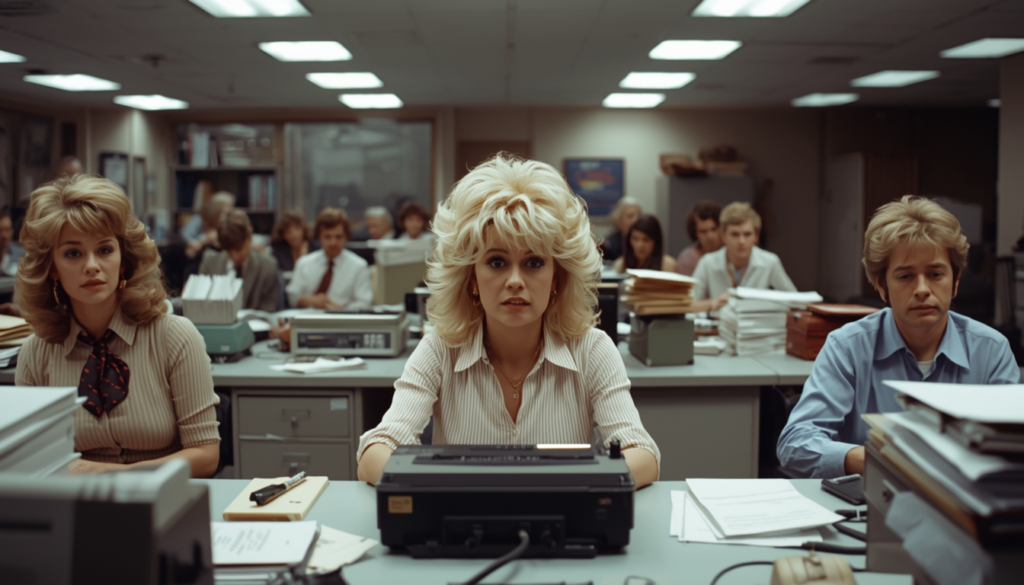
Women Work and the Struggle for Recognition
The film gives the song another important dimension. Its three central characters are women confronting sexism, harassment and condescension within the workplace.
The working women and gender discrimination in Dolly Parton song therefore reflect the wider social context surrounding its creation.
The System Isn’t Necessarily Fair
Parton doesn’t merely criticise an unpleasant boss. She questions a hierarchy in which wealth and power accumulate towards the top while those performing much of the everyday work struggle for recognition.
Frustration Can Become Solidarity
This is where I think the cheerful arrangement becomes particularly clever.
“9 to 5” doesn’t sound defeated.
Its rhythm practically bounces out of the speakers. The contrast between upbeat music and frustrated lyrics transforms complaint into defiance. Instead of portraying workers as helpless victims, Parton creates a sense that everybody experiencing the same problems is part of something larger.
That resilience connects naturally with the wider Life Lessons in Song and with the determination heard in Janis Joplin’s Piece of My Heart.
Ambition Exploitation and the Struggle for Recognition
The ambition exploitation and the struggle for recognition at the heart of “9 to 5” explain why the song still feels relevant decades later.
Technology has changed enormously since 1980. Workplace frustrations haven’t disappeared with the typewriter.
Hope Survives the Daily Grind
For all its criticism, I don’t hear “9 to 5” as a pessimistic song.
The characters still dream.
That matters because aspiration is the thing the workplace hasn’t managed to take from them. The system may restrict opportunity, but it hasn’t completely extinguished the belief that life could become better.
Parton’s emotional storytelling takes very different forms in Jolene, Here You Come Again and Me and Bobby McGee. Similar emotional resilience can be found in Belinda Carlisle’s Heaven Is a Place on Earth.
Frequently Asked Question
Conclusion
Ultimately, the Dolly Parton 9 to 5 Lyrics Meaning combines frustration with determination. Parton recognises an unfair system without allowing that system to have the final word.
The job may belong to the employer.
Your ambition still belongs to you.
“Work that costs you joy is charging interest on your energy.”
Stephenism
🎵 Soul from the Solo Blogger — Tunes from Túrail.